AI-Enabled Real-Time Data Pipelines for Intelligent Event Processing

Introduction
The rapid growth of digital technologies has transformed the way organizations generate, collect, and use data. Applications, connected devices, online transactions, enterprise systems, and digital platforms continuously produce streams of information. For many organizations, the value of this information depends on how quickly it can be processed and converted into actionable insight. Traditional batch-oriented data architectures often introduce delays that prevent businesses from responding effectively to events as they occur. As a result, enterprises are increasingly adopting real-time data pipelines enhanced by Artificial Intelligence (AI).
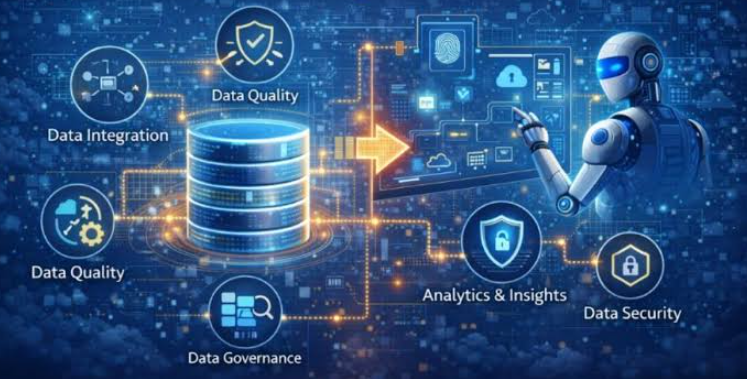
AI-enabled real-time data pipelines combine continuous data ingestion, stream processing, machine learning, intelligent decision-making, and automated actions. Instead of simply moving data from one system to another, these pipelines can interpret incoming events, identify patterns, detect anomalies, predict outcomes, and initiate appropriate responses. This capability supports intelligent event processing across industries such as finance, healthcare, manufacturing, retail, telecommunications, logistics, and cybersecurity.
Real-Time Data Pipelines
A real-time data pipeline is a system designed to collect and process information continuously as it becomes available. Unlike traditional pipelines that may process data hourly, daily, or weekly, real-time pipelines operate continuously and aim to minimize the delay between an event occurring and its analysis.
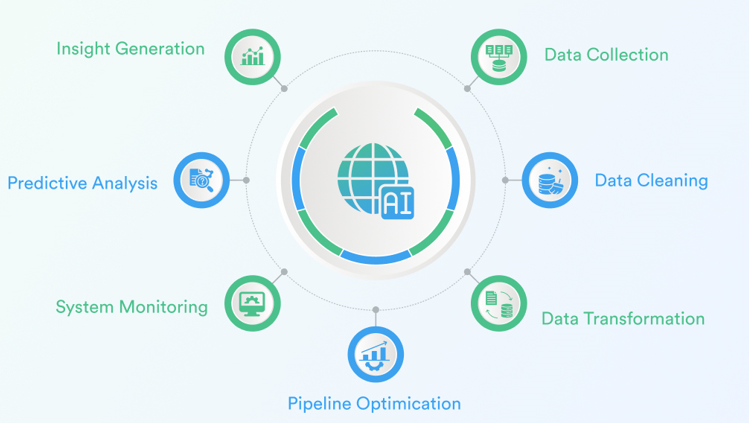
Data can originate from numerous sources, including enterprise applications, sensors, websites, mobile applications, transaction systems, databases, and external services. An ingestion layer receives these events and transfers them to distributed streaming infrastructure. Stream-processing components then filter, transform, enrich, aggregate, and analyze the incoming information.
The processed data can be stored in operational databases, analytical platforms, data lakes, or specialized event stores. More importantly, the results can immediately reach business applications, dashboards, alerting systems, or automated workflows.
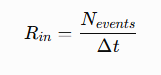
EQ1:Data Ingestion Rate
Role of Artificial Intelligence
The integration of AI significantly extends the capabilities of real-time data pipelines. Conventional stream-processing systems generally operate according to predefined rules. For example, a system might generate an alert whenever a transaction exceeds a particular threshold. While such rules remain useful, they may not adequately capture complex or evolving patterns.
AI enables pipelines to analyze events using machine learning models and advanced analytical techniques. Models can recognize relationships among multiple events, identify unusual behavior, classify incoming information, and generate predictions.
For example, a financial institution can use AI to examine transaction patterns in real time. Instead of relying exclusively on fixed fraud rules, a machine learning model can consider customer behavior, transaction history, location, device information, and other contextual signals. The system can then identify transactions that appear inconsistent with normal behavior and initiate additional verification.
Intelligent Event Processing
Intelligent event processing focuses on understanding individual events as well as relationships between events occurring over time. An event may represent a purchase, login, machine reading, delivery update, network connection, or customer interaction.
AI-enabled systems can perform several forms of event intelligence. Event classification determines the category or significance of an incoming event. Anomaly detection identifies behavior that differs substantially from expected patterns. Predictive analytics estimates what may happen next based on historical and current information. Pattern recognition identifies meaningful combinations of events that may indicate business opportunities or risks.
Context is particularly important. A single event may not provide enough information to support a decision. When combined with historical information, customer profiles, operational conditions, and related events, the same event can become much more meaningful.
Architecture of an AI-Enabled Pipeline
An AI-enabled real-time pipeline generally consists of several interconnected layers.
The data source layer generates events from applications, devices, databases, and external systems. These sources may produce structured, semi-structured, or unstructured information.
The event ingestion layer captures and transports data continuously. Distributed messaging systems are commonly used to provide scalability, reliability, and fault tolerance.
The stream-processing layer performs initial transformations and prepares events for intelligent analysis. It may remove irrelevant information, normalize formats, combine events, and enrich them with additional context.
The AI and machine learning layer applies models to incoming data. Depending on the application, models may perform classification, recommendation, forecasting, anomaly detection, or natural-language analysis.
The decision layer converts model outputs into business decisions. These decisions may trigger notifications, automated workflows, transaction approvals, security responses, or recommendations to human users.
Finally, the storage and monitoring layer preserves relevant information for historical analysis, model development, auditing, and system monitoring.
Continuous Learning and Model Adaptation
One of the most important advantages of AI-enabled pipelines is their potential for continuous learning. Business environments are rarely static. Customer behavior changes, new fraud strategies emerge, machine conditions evolve, and market conditions fluctuate.
A model trained on historical data may gradually become less effective if these patterns change. AI-enabled architectures can therefore incorporate mechanisms for model monitoring, retraining, validation, and deployment.
Continuous monitoring can identify declining model performance, changes in incoming data, or unexpected prediction patterns. When necessary, updated models can be introduced into the pipeline. This creates a feedback loop in which real-time events contribute to improving future decisions.
However, automated model adaptation must be carefully governed. Poor-quality data or unexpected changes can cause models to learn incorrect patterns. Human oversight remains important, particularly for high-impact business decisions.
Applications Across Industries
AI-enabled real-time pipelines have broad applications.
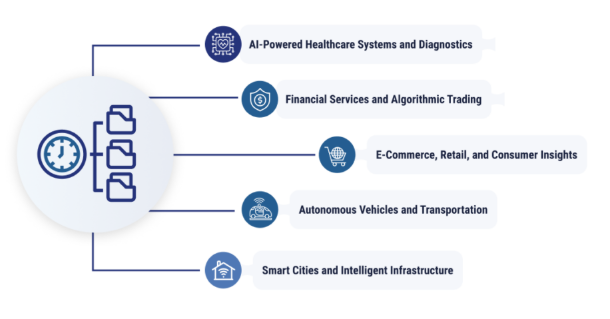
In banking and financial services, they support fraud detection, risk monitoring, algorithmic decision support, and transaction analysis. Rapid identification of suspicious behavior can reduce financial losses and improve security.
In manufacturing, real-time sensor data can be combined with machine learning to detect equipment abnormalities and predict maintenance requirements. This can reduce downtime and improve production efficiency.
In retail, customer interactions, inventory movements, purchasing behavior, and website activity can be processed continuously. AI can use these signals to generate personalized recommendations and identify changing demand.
In telecommunications, streaming analytics can identify network problems, unusual traffic, and service degradation. AI can help predict failures and support automated network optimization.
In cybersecurity, real-time pipelines can analyze authentication events, network activity, application logs, and other security signals. AI-based anomaly detection can identify potentially malicious behavior more rapidly than manual analysis.
EQ2:Processing Throughput

Benefits
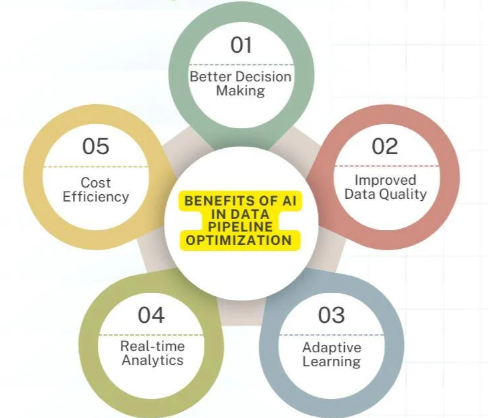
The primary advantage of AI-enabled real-time pipelines is faster decision-making. Organizations can act on information while it remains relevant rather than waiting for periodic reports.
They also improve automation. AI can evaluate large numbers of events continuously and trigger appropriate actions without requiring human intervention for every individual event.
Another benefit is scalability. Distributed architectures can process large volumes of events from multiple sources while maintaining operational performance.
AI-enabled pipelines can also improve situational awareness by combining real-time information with historical and contextual data. This gives decision-makers a more complete understanding of changing business conditions.
Challenges
Despite their advantages, AI-enabled real-time pipelines introduce technical and organizational challenges. Managing high-volume event streams requires reliable and scalable infrastructure. Low-latency processing can also require significant computational resources.
Data quality is another major concern. Inaccurate, incomplete, duplicated, or delayed data can reduce the reliability of AI predictions.
Organizations must also address security, privacy, and governance. Real-time pipelines may process sensitive customer, financial, operational, or personal information. Appropriate access controls, encryption, auditing, and data governance are therefore essential.
AI models introduce additional concerns involving explainability, bias, model drift, and reliability. Enterprises need monitoring mechanisms to ensure that automated decisions remain accurate and appropriate.
Future Directions
The future of AI-enabled real-time data processing is likely to involve greater automation and intelligence. Edge computing will allow AI models to operate closer to data-generating devices, reducing communication delays and enabling rapid local decisions.
Generative AI may also become increasingly integrated with event-processing systems. Instead of simply generating numerical predictions or alerts, intelligent systems may summarize events, explain detected patterns, recommend actions, and assist operators in responding to complex situations.
Another important development is the emergence of autonomous data pipelines capable of dynamically adjusting processing resources, selecting analytical strategies, and responding to changing workloads.
Conclusion
AI-enabled real-time data pipelines represent a significant advancement in enterprise data processing. By combining continuous event ingestion with machine learning, contextual analysis, intelligent decision-making, and automated responses, organizations can transform rapidly arriving data into immediate business value.
The future of intelligent event processing will depend not only on processing data quickly but also on understanding its meaning and responding appropriately. Organizations that successfully integrate AI with reliable real-time architectures can build more responsive, efficient, secure, and intelligent operations capable of adapting to an increasingly dynamic digital environment.
Comments
Join the discussionNo comments yet. Be the first to comment.