Agentic AI for Autonomous Enterprise Data Lifecycle Management

Introduction
Data has become one of the most valuable assets for modern enterprises, driving strategic decision-making, operational efficiency, customer engagement, and innovation. Organizations generate massive volumes of structured, semi-structured, and unstructured data from business applications, cloud services, Internet of Things (IoT) devices, social media platforms, and digital transactions. Managing this continuously growing data throughout its lifecycle has become increasingly complex due to evolving business requirements, regulatory obligations, and rapidly changing technology landscapes. Traditional data lifecycle management approaches rely heavily on manual intervention, predefined workflows, and rule-based automation, which often struggle to keep pace with dynamic enterprise environments.
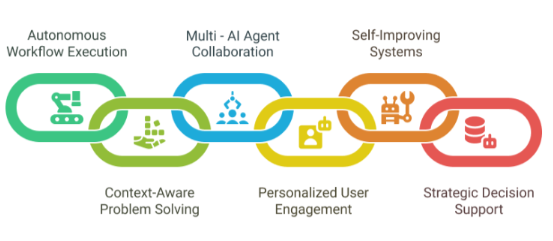
Agentic Artificial Intelligence (Agentic AI) introduces a transformative paradigm for enterprise data management by enabling autonomous, intelligent, and goal-oriented decision-making across the entire data lifecycle. Unlike conventional AI systems that primarily provide predictions or recommendations, Agentic AI consists of autonomous software agents capable of perceiving their environment, reasoning about objectives, making independent decisions, collaborating with other agents, and continuously learning from outcomes. These intelligent agents can automate complex data management activities with minimal human supervision while adapting to changing enterprise conditions. As organizations embrace digital transformation, Agentic AI is emerging as a critical technology for building self-managing enterprise data ecosystems that improve operational efficiency, governance, and business agility.
Understanding Enterprise Data Lifecycle Management
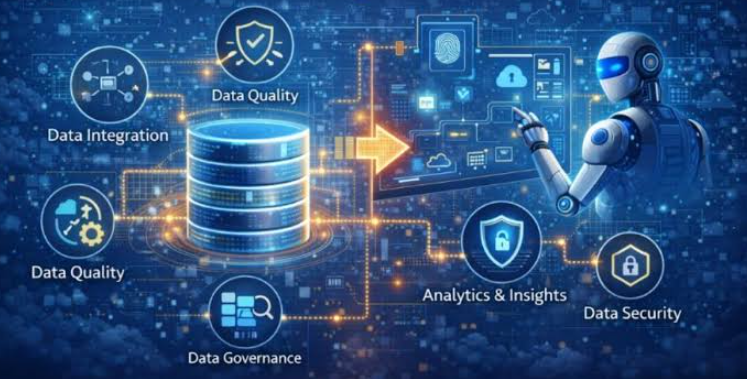
Enterprise data lifecycle management encompasses all stages through which data passes, beginning with data generation or acquisition and continuing through storage, integration, processing, analysis, sharing, archival, and eventual disposal. Each stage requires careful management to ensure data quality, security, accessibility, compliance, and business value.
The lifecycle typically includes data collection from multiple internal and external sources, data validation and cleansing, integration across enterprise systems, storage in databases or cloud repositories, analytical processing, business consumption, long-term retention, and secure deletion when data is no longer required. Throughout these stages, organizations must maintain governance policies, monitor data quality, enforce security controls, and comply with industry regulations.
As enterprise infrastructures become increasingly distributed across hybrid cloud, multi-cloud, and edge computing environments, managing these lifecycle processes manually becomes increasingly difficult. Autonomous lifecycle management powered by Agentic AI offers an intelligent solution to these challenges.
EQ1:Enterprise Data Repository

The Concept of Agentic AI
Agentic AI represents the next evolution of artificial intelligence by emphasizing autonomous action rather than passive prediction. Agentic AI systems consist of intelligent agents that possess capabilities such as environmental perception, reasoning, planning, memory, collaboration, adaptation, and autonomous execution.
Each agent is assigned specific objectives while maintaining awareness of broader organizational goals. Rather than waiting for human instructions at every step, these agents proactively identify problems, evaluate alternative solutions, execute appropriate actions, monitor results, and continuously improve their performance through learning.
Within enterprise data platforms, multiple specialized agents collaborate to manage different aspects of the data lifecycle. For example, one agent may monitor data quality, another may oversee governance compliance, while others optimize storage resources, automate metadata generation, or secure sensitive information. Together, these agents create an intelligent ecosystem capable of self-management.
Autonomous Data Collection and Integration
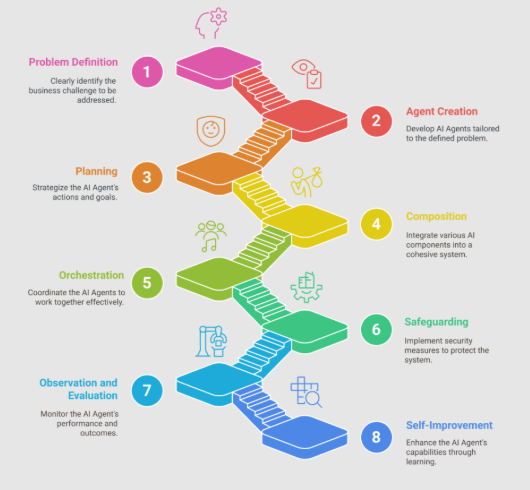
One of the earliest stages of the data lifecycle involves collecting information from numerous enterprise systems, cloud services, external partners, IoT devices, and streaming applications. Traditional integration pipelines require significant manual configuration whenever new data sources are introduced.
Agentic AI automates this process by intelligently discovering new data sources, evaluating their relevance, establishing secure connections, and integrating them into enterprise platforms without extensive human intervention. Intelligent agents continuously monitor incoming data streams, detect schema changes, identify inconsistencies, and dynamically adjust integration workflows.
These agents also resolve data format incompatibilities, standardize naming conventions, and coordinate with metadata management systems to document newly integrated datasets. Such automation significantly accelerates enterprise data onboarding while reducing operational complexity.
Intelligent Data Quality Management
High-quality data is essential for reliable analytics and effective business decision-making. However, maintaining data quality across thousands of enterprise datasets remains a persistent challenge due to duplication, missing values, inconsistent formats, outdated records, and inaccurate information.
Agentic AI continuously monitors data quality throughout the lifecycle. Intelligent agents automatically detect anomalies, identify duplicate records, validate business rules, and recommend corrective actions. Rather than simply reporting quality issues, autonomous agents initiate remediation workflows, repair inconsistencies where appropriate, and verify that corrections meet organizational standards.
These agents learn from historical quality patterns, enabling them to anticipate recurring problems and proactively prevent future errors. Continuous quality management improves trust in enterprise data assets while reducing manual validation efforts.
Adaptive Data Governance and Compliance
Modern enterprises operate within increasingly complex regulatory environments that require strict compliance with privacy, security, and industry-specific regulations. Data governance traditionally depends on manually enforced policies and periodic audits, making it difficult to respond quickly to changing compliance requirements.
Agentic AI transforms governance into an adaptive, continuously operating process. Governance agents automatically classify sensitive information, monitor access permissions, enforce organizational policies, track regulatory requirements, and maintain complete audit trails.
When policy violations or unusual activities are detected, autonomous agents immediately investigate the issue, recommend corrective measures, notify responsible stakeholders, and initiate predefined mitigation procedures. Continuous governance ensures that enterprise data remains compliant while reducing administrative overhead.
Intelligent Storage Optimization
Enterprise organizations store data across multiple cloud providers, on-premises systems, data lakes, warehouses, and archival repositories. Determining the most efficient storage location requires balancing performance, accessibility, security, cost, and compliance considerations.
Agentic AI optimizes storage management by continuously analyzing data usage patterns, business priorities, storage costs, and performance requirements. Intelligent agents automatically migrate frequently accessed datasets to high-performance storage while archiving inactive information to cost-effective repositories.
As organizational requirements evolve, agents dynamically rebalance storage resources without disrupting business operations. This intelligent optimization improves system performance while reducing infrastructure expenses.
Autonomous Metadata and Knowledge Management
Metadata serves as the foundation for effective enterprise data discovery, governance, and understanding. Maintaining accurate metadata manually is increasingly difficult as enterprise data environments expand.
Agentic AI automatically generates, updates, and enriches metadata throughout the data lifecycle. Specialized agents analyze datasets, transformation processes, business documentation, and user interactions to create comprehensive metadata describing data origin, quality, ownership, relationships, and usage.
Autonomous metadata management also improves enterprise knowledge sharing by maintaining business glossaries, semantic relationships, and intelligent data catalogs. Business users can easily discover trusted datasets using natural language queries, improving collaboration across departments.
Intelligent Security and Risk Management
Protecting enterprise data from cyber threats, unauthorized access, and accidental exposure is a critical responsibility throughout the data lifecycle. Traditional security systems often rely on static rules that cannot effectively respond to evolving attack techniques.
Agentic AI introduces adaptive security by continuously monitoring user behavior, access patterns, system activities, and network communications. Security agents identify anomalies, assess potential risks, and autonomously implement protective measures such as access restrictions, encryption updates, authentication requirements, or incident containment.
These intelligent agents collaborate with governance and compliance systems to ensure that security decisions align with organizational policies while minimizing disruption to legitimate business activities.
Collaboration Among Autonomous Agents
A distinguishing characteristic of Agentic AI is collaborative intelligence. Rather than functioning independently, multiple autonomous agents communicate, exchange knowledge, coordinate decisions, and jointly optimize enterprise operations.
For example, when a new dataset enters the platform, one agent may validate data quality while another generates metadata, a third verifies governance compliance, and a fourth determines the optimal storage location. Additional agents monitor security risks and update enterprise knowledge repositories simultaneously.
This collaborative architecture creates an integrated ecosystem where decisions are coordinated across the entire enterprise data lifecycle instead of being isolated within individual systems.
Business Benefits
Implementing Agentic AI for autonomous enterprise data lifecycle management provides substantial organizational advantages. Automation significantly reduces manual administrative effort, allowing data professionals to focus on higher-value strategic initiatives. Continuous monitoring improves data quality, governance, security, and compliance while reducing operational risks.
Organizations benefit from faster data integration, accelerated analytics development, improved decision-making, lower infrastructure costs, enhanced regulatory compliance, and greater operational resilience. Intelligent automation also enables enterprises to scale data operations efficiently as business requirements evolve.
Furthermore, autonomous lifecycle management increases organizational agility by allowing enterprise data platforms to adapt automatically to changing workloads, technologies, and business priorities without extensive manual reconfiguration.
Challenges and Future Directions
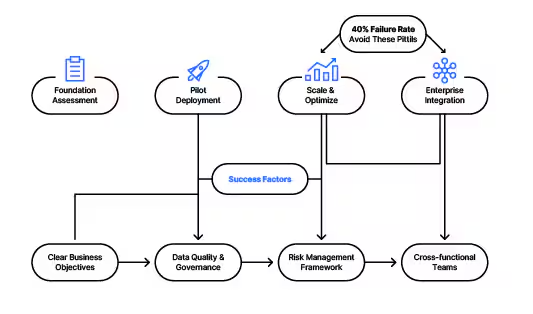
Despite its significant potential, implementing Agentic AI presents several challenges. Organizations must establish robust governance frameworks to ensure autonomous agents make transparent, ethical, and accountable decisions. Integrating AI agents with legacy enterprise systems may require substantial modernization efforts. Maintaining trust in autonomous decision-making also requires explainability, continuous monitoring, and appropriate human oversight.
Future developments will likely introduce increasingly sophisticated multi-agent ecosystems capable of negotiating priorities, optimizing enterprise objectives collectively, and learning continuously from organizational experiences. Advances in explainable AI, federated learning, knowledge graphs, and autonomous orchestration will further enhance the capabilities of intelligent enterprise data platforms.
Agentic AI is also expected to integrate seamlessly with emerging technologies such as digital twins, edge computing, blockchain, and quantum computing, enabling highly adaptive and resilient enterprise data ecosystems.
Conclusion
Agentic AI represents a significant advancement in enterprise data lifecycle management by introducing autonomous, intelligent, and collaborative decision-making across every stage of the data lifecycle. Through specialized AI agents capable of learning, reasoning, planning, and acting independently, organizations can automate data collection, integration, quality management, governance, security, metadata generation, storage optimization, and compliance monitoring. This intelligent approach transforms traditional data management into a self-managing ecosystem that continuously adapts to changing business environments while improving efficiency, reliability, and governance. As enterprises continue their digital transformation journeys, Agentic AI will play a central role in building resilient, scalable, and intelligent data platforms capable of maximizing the long-term value of enterprise information assets.
Comments
Join the discussionNo comments yet. Be the first to comment.