Explainable Artificial Intelligence: Bridging Transparency and Trust

Introduction
Artificial Intelligence (AI) has rapidly transformed industries ranging from healthcare and finance to transportation and governance. Algorithms now make decisions that directly affect human lives—diagnosing diseases, approving loans, guiding autonomous vehicles, and even supporting criminal justice decisions. While AI offers tremendous benefits in speed, efficiency, and predictive power, one persistent challenge undermines its full adoption: the “black box” problem. Many advanced AI models, particularly deep learning networks, operate with high accuracy but lack transparency, making it difficult to understand how they reach conclusions.
This opacity has given rise to the field of Explainable Artificial Intelligence (XAI), which seeks to make AI systems more interpretable, transparent, and trustworthy. By bridging the gap between complex algorithms and human understanding, XAI ensures that users and stakeholders can trust, verify, and ethically adopt AI solutions. This article explores the importance of XAI, its methodologies, applications, challenges, and future directions.
EQ1:Feature Importance (Linear Model Example)

The Black Box Problem in AI
Traditional machine learning models like decision trees or linear regression are relatively easy to interpret. However, modern AI relies on highly complex architectures—such as deep neural networks with millions of parameters—that operate in ways even experts struggle to understand.
For example, an AI model may accurately diagnose a tumor from medical imaging, but doctors might not know which features the system considered most important. Similarly, a financial AI system might reject a loan application without offering a clear justification. This lack of transparency creates concerns in several areas:
Trust: Users may hesitate to rely on AI if they cannot understand its reasoning.
Accountability: If an AI system makes a harmful decision, responsibility must be assigned.
Bias and Fairness: Hidden biases in training data may lead to discriminatory outcomes.
Regulatory Compliance: Industries like healthcare and finance require explainability to meet legal and ethical standards.
XAI addresses these challenges by ensuring that AI systems not only perform well but also explain their decision-making processes in ways humans can understand.
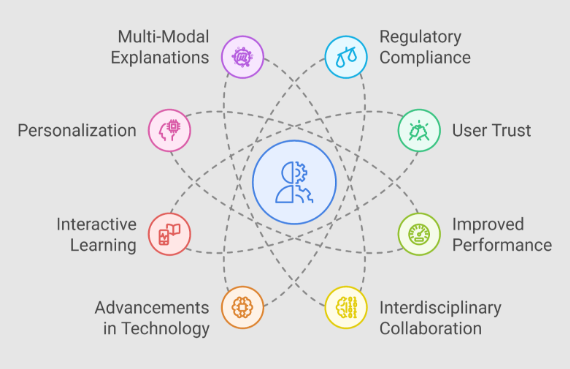
What is Explainable AI?
Explainable Artificial Intelligence refers to methods and techniques that make AI outcomes transparent and interpretable. The goal is not only to show what the system decided but also why and how it reached that conclusion.
XAI typically balances two competing needs:
Accuracy and Performance: Complex models like deep learning achieve high accuracy but are hard to interpret.
Interpretability: Simpler models are easier to understand but may sacrifice performance.
The role of XAI is to find a middle ground where AI systems remain powerful while still providing human-understandable explanations.
Methods of Explainable AI
XAI employs various techniques, which can be broadly divided into intrinsic and post-hoc methods.
Intrinsic Interpretability:
These are models that are inherently understandable by design. Examples include:Decision trees: Show explicit decision rules.
Linear models: Show how input features contribute to the output.
Rule-based systems: Provide human-readable if–then rules.
Post-hoc Explainability:
These methods provide explanations after a complex model has made a decision. Examples include:Feature Importance: Identifies which features influenced the decision most.
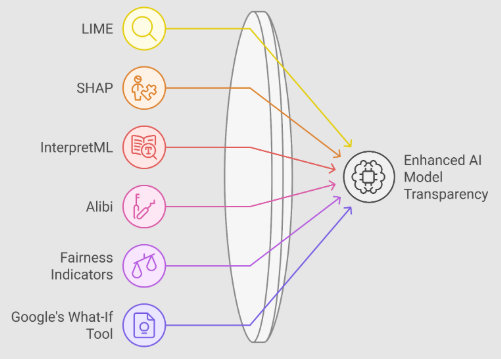
Local Interpretable Model-Agnostic Explanations (LIME): Approximates the behavior of black-box models locally for a given prediction.
SHAP (Shapley Additive Explanations): Uses game theory to assign importance values to features.
Visualization Tools: Heatmaps in image recognition highlight which parts of an image influenced classification.
Counterfactual Explanations: Explain decisions by showing how small changes in input could alter the outcome (e.g., “If your income were $5,000 higher, the loan would have been approved”).
These methods ensure that both experts and non-technical stakeholders can gain insight into how AI systems function.
Applications of XAI
Healthcare:
Doctors need to trust AI systems that assist in diagnosing diseases. XAI provides transparency in diagnostic tools, showing which features of a medical image led to a certain prediction. This builds confidence in using AI as a clinical partner rather than an opaque tool.Finance:
AI is widely used for credit scoring, fraud detection, and investment decisions. XAI ensures that loan approvals or rejections are justifiable and free from bias, which is essential for regulatory compliance.Autonomous Vehicles:
Self-driving cars rely on AI to make real-time navigation decisions. XAI helps engineers understand why a vehicle chose a specific maneuver, improving safety and accountability in case of accidents.Law and Governance:
Predictive policing and judicial decision-support systems raise ethical concerns. XAI ensures that such models remain transparent and do not reinforce societal biases.Human Resources:
AI systems increasingly support recruitment by screening resumes and recommending candidates. XAI helps ensure that hiring algorithms remain fair, unbiased, and explainable to applicants.
Benefits of Explainable AI
Trust Building: By making AI decisions understandable, users are more likely to adopt and rely on AI systems.
Improved Accountability: Clear explanations help assign responsibility when errors occur.
Bias Detection and Mitigation: Transparency enables the identification of unfair patterns in training data.
Regulatory Compliance: Many industries require explainability to meet legal frameworks, such as GDPR’s “right to explanation.”
Enhanced Human–AI Collaboration: Explanations allow humans and AI systems to work together more effectively by leveraging each other’s strengths.
Challenges of XAI
Despite its promise, XAI faces several challenges:
Trade-off Between Accuracy and Interpretability: The most interpretable models are not always the most accurate, forcing difficult choices.
Complexity of Explanations: Explanations must be understandable to non-experts while still accurate and comprehensive.
Scalability: Applying explainability methods across large, real-time systems can be resource-intensive.
Potential Misinterpretation: Simplified explanations might mislead users into overtrusting or misunderstanding AI decisions.
Standardization: There is no universal standard for what constitutes a “good explanation,” making it difficult to benchmark models.
Ethical and Legal Implications
XAI is not just a technical challenge but also an ethical and legal necessity. When AI decisions impact human rights—such as access to healthcare, employment, or justice—citizens deserve explanations. Regulations like the European Union’s GDPR emphasize the “right to explanation,” pushing industries to adopt transparent models.
Ethically, XAI ensures fairness by exposing biases in data and models. It also strengthens democratic governance by ensuring that AI in public policy remains accountable and open to scrutiny.
EQ2:SHAP (Shapley Additive Explanations)

Future Directions
The future of XAI lies in developing models that are both high-performing and inherently interpretable. Some promising directions include:
Hybrid Models: Combining interpretable models with black-box systems to balance performance and transparency.
Interactive Explanations: Providing users with dynamic tools to query and explore AI decisions.
Causal Explanations: Moving beyond correlation to provide causal insights into model behavior.
Personalized Explanations: Tailoring the level of detail to different stakeholders—engineers, regulators, or everyday users.
Integration with Ethical AI Frameworks: Embedding fairness, accountability, and transparency into AI systems from the ground up.
These advances will help establish XAI as a cornerstone of trustworthy AI.

Conclusion
As AI becomes increasingly embedded in the fabric of modern life, its lack of transparency poses a significant barrier to trust, accountability, and ethical adoption. Explainable Artificial Intelligence emerges as a solution, ensuring that AI systems remain understandable, fair, and accountable. By making complex models interpretable, XAI builds confidence in AI-driven decisions across critical domains such as healthcare, finance, transportation, and governance.
The journey toward fully explainable AI is ongoing, requiring technical innovation, ethical reflection, and regulatory oversight. Yet its importance cannot be overstated: transparency is the foundation of trust, and without trust, even the most powerful AI systems will fail to achieve their full potential. XAI thus represents not just a technical innovation but a societal imperative, bridging the gap between machine intelligence and human values.
Comments
Join the discussionNo comments yet. Be the first to comment.