Intelligent Data Engineering Frameworks for Large-Scale IoT Ecosystems

Introduction
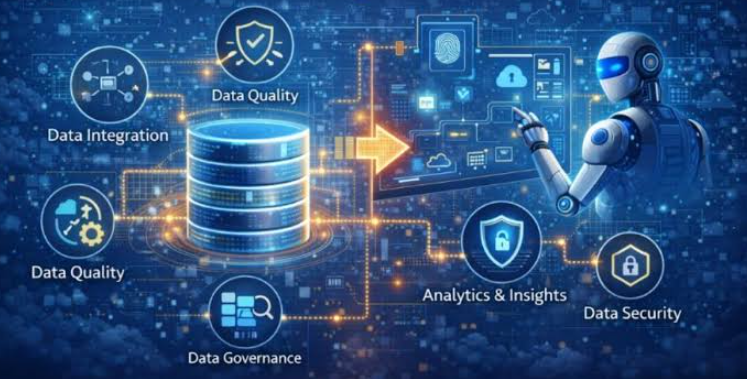
The Internet of Things (IoT) has transformed the way organizations collect, process, and utilize data. Connected sensors, industrial machines, smart devices, vehicles, healthcare systems, energy infrastructure, and enterprise equipment continuously generate enormous quantities of data. As IoT ecosystems expand, traditional data engineering approaches are increasingly challenged by the volume, velocity, variety, and complexity of information produced by distributed devices. Intelligent Data Engineering Frameworks provide an advanced approach for managing these environments by integrating artificial intelligence, machine learning, cloud computing, edge computing, real-time analytics, automation, and intelligent orchestration.
An intelligent data engineering framework enables organizations to move beyond conventional data pipelines toward adaptive systems capable of continuously monitoring, processing, optimizing, and governing IoT data. Such frameworks can improve data quality, reduce processing latency, optimize infrastructure utilization, and support real-time decision-making. They are particularly important for large-scale IoT ecosystems where millions of devices may operate simultaneously across geographically distributed environments.
Evolution of IoT Data Engineering
Traditional IoT data architectures generally rely on predefined pipelines for collecting sensor information, transmitting it to centralized platforms, transforming it, and storing it for analytics. Although this approach works effectively for relatively stable environments, large-scale IoT deployments introduce constantly changing conditions. Devices may join or leave networks, communication quality can fluctuate, sensor behavior can change, and data volumes can increase unexpectedly.
Intelligent data engineering addresses these challenges by introducing adaptive decision-making into the data lifecycle. Instead of relying exclusively on static rules, intelligent frameworks can analyze historical and real-time information to determine how data should be collected, processed, stored, and transmitted. Machine learning models can identify patterns in data streams, while intelligent orchestration mechanisms can dynamically adjust processing resources and workflows.
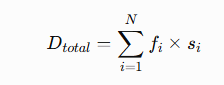
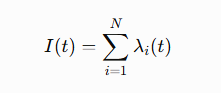
EQ1:IoT Data Generation Rate
Architecture of Intelligent IoT Data Engineering
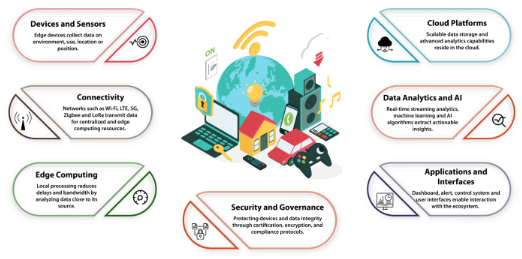
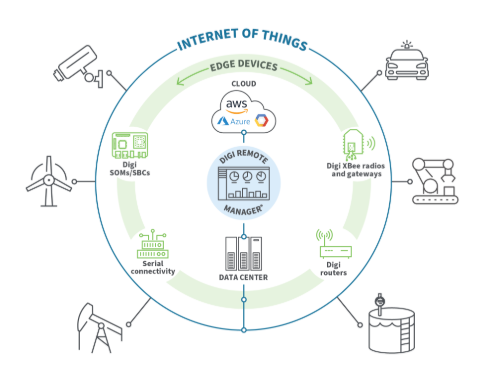
An intelligent IoT data engineering framework typically consists of several interconnected layers. At the device layer, sensors, machines, vehicles, and smart devices generate continuous streams of information. The connectivity layer transports this information through wireless networks, industrial communication systems, and other communication technologies.
The edge computing layer provides localized processing close to data sources. Instead of transmitting every event to centralized cloud infrastructure, edge nodes can filter, aggregate, analyze, and prioritize information locally. This significantly reduces network traffic and enables faster responses to time-sensitive events.
The data ingestion layer receives information from multiple IoT sources and converts it into standardized formats. Streaming platforms can process continuous event flows, while message brokers can support reliable communication between devices and backend systems.
The cloud and data platform layer provides scalable storage, advanced processing, analytics, and machine learning capabilities. Above these components, an intelligent orchestration layer manages workloads, identifies operational problems, and dynamically optimizes the overall data engineering environment.
Intelligent Data Ingestion
IoT ecosystems generate data at different frequencies and formats. A temperature sensor may produce measurements every few seconds, while industrial equipment may generate thousands of events per second. Intelligent ingestion mechanisms are therefore required to manage heterogeneous workloads efficiently.
AI-based ingestion systems can classify incoming events according to their importance and urgency. Critical events can be processed immediately, while low-priority information can be aggregated or transferred during less congested periods. Intelligent routing can also determine whether information should be processed at the edge, transmitted to the cloud, or stored for later analysis.
Such adaptive ingestion reduces unnecessary data movement while ensuring that important information reaches analytical systems with minimal delay.
Edge Intelligence and Distributed Processing
Edge computing is an essential component of intelligent IoT data engineering. Centralized processing can introduce network latency and significant bandwidth requirements when massive quantities of sensor data are continuously transmitted to the cloud.
Intelligent edge processing enables local systems to make preliminary decisions. Machine learning models deployed at edge locations can identify anomalies, classify events, and detect operational conditions without sending every raw data point to centralized infrastructure.
For example, an industrial edge system can analyze vibration data from machinery and immediately identify unusual operating patterns. Only relevant events or summarized information may then be transmitted to a central platform. This architecture improves responsiveness while reducing communication costs.
Real-Time IoT Data Processing
Large-scale IoT applications frequently require real-time data processing. Smart manufacturing, autonomous transportation, energy monitoring, security systems, and predictive maintenance depend on timely analysis of incoming events.
Intelligent streaming pipelines can continuously examine IoT data and identify important events. AI models can detect abnormal behavior, forecast potential failures, and classify operational conditions as data arrives. The resulting insights can be integrated with enterprise applications to support automated responses.
Real-time processing also enables organizations to move from reactive to predictive operations. Instead of waiting for equipment failure, organizations can identify early warning signals and schedule maintenance before major disruptions occur.
AI-Based Data Quality Management
Data quality is a major challenge in IoT environments because sensors can produce missing, duplicated, inconsistent, or inaccurate information. Device malfunctions, network interruptions, calibration problems, and environmental conditions can all affect data reliability.
Intelligent data quality systems can continuously monitor IoT streams and identify abnormal values. Machine learning techniques can distinguish between genuine operational changes and potential sensor errors. Missing information can sometimes be reconstructed using historical patterns, correlated sensors, or contextual information.
Automated quality management improves the reliability of downstream analytics and reduces the amount of manual effort required to inspect sensor data.
Intelligent Data Storage and Lifecycle Management
IoT environments can generate enormous amounts of historical information. Storing all raw data indefinitely can create substantial infrastructure costs. Intelligent storage management can classify information according to business value, frequency of access, regulatory requirements, and analytical importance.
Frequently accessed information can remain in high-performance storage, while older or less important data can be transferred to lower-cost storage environments. Intelligent lifecycle management can also determine which information should be retained, archived, aggregated, or deleted according to organizational policies.
This approach enables enterprises to balance analytical requirements with storage efficiency.
EQ2:Intelligent Data Ingestion Rate
Autonomous Pipeline Optimization
Large IoT data pipelines operate under continuously changing workloads. An intelligent framework can monitor processing performance and automatically adjust resources according to demand.
For example, when a large number of devices suddenly become active, the system can increase processing capacity. When workloads decline, resources can be reduced to minimize unnecessary expenditure. Intelligent optimization can consider processing latency, infrastructure utilization, workload priority, and cost.
This capability is particularly valuable in cloud environments where resources can be dynamically allocated.
Security and Governance
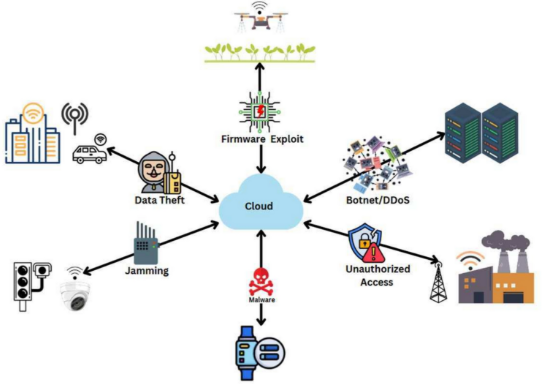
The scale and distribution of IoT ecosystems create significant security and governance requirements. IoT data may contain sensitive operational, customer, location, or industrial information. Unauthorized access or manipulation can have serious consequences.
Intelligent data engineering frameworks can integrate authentication, authorization, encryption, anomaly detection, and policy enforcement into data pipelines. AI-based security mechanisms can monitor device behavior and identify unusual access patterns or communication activities.
Data governance mechanisms can also maintain lineage, track data movement, enforce retention policies, and ensure that information is handled according to organizational and regulatory requirements.
Digital Twins and Predictive Analytics
Intelligent IoT data engineering can support digital twin technologies by continuously integrating sensor information with virtual representations of physical systems. A digital twin can provide an up-to-date view of equipment, infrastructure, or industrial processes.
When combined with predictive analytics, digital twins can help organizations evaluate operational scenarios, identify potential failures, and optimize processes. Intelligent data pipelines ensure that digital twins receive reliable and timely information from distributed IoT devices.
Challenges
Despite its benefits, implementing intelligent data engineering for large-scale IoT ecosystems presents several challenges. Organizations must manage heterogeneous devices, inconsistent data formats, network limitations, security threats, model accuracy, and infrastructure complexity.
Another challenge involves deploying AI models across resource-constrained edge devices. Models must often be optimized to operate with limited computational power and energy. Organizations also need effective monitoring mechanisms to ensure that intelligent systems continue to perform correctly as environments change.
Interoperability is another important consideration. IoT ecosystems often include devices and platforms from different vendors, making standardized interfaces and communication mechanisms essential.
Future Directions
Future intelligent IoT data engineering frameworks are expected to become increasingly autonomous and adaptive. Agentic AI can enable systems to independently coordinate data ingestion, pipeline optimization, anomaly detection, resource allocation, and governance activities.
Federated learning can allow machine learning models to learn from distributed IoT environments without requiring all raw information to be transferred to a central platform. Edge AI is also likely to become more sophisticated, enabling increasingly complex analytics directly at the data source.
Integration between IoT, cloud computing, edge intelligence, digital twins, generative AI, and autonomous orchestration will further strengthen the ability of organizations to manage complex connected environments.
Conclusion
Intelligent Data Engineering Frameworks provide a scalable and adaptive foundation for large-scale IoT ecosystems. By combining intelligent ingestion, edge processing, real-time analytics, AI-driven quality management, automated storage optimization, security, governance, and autonomous orchestration, organizations can transform massive IoT data streams into reliable and actionable information.
The future of IoT data engineering will increasingly depend on systems that can understand changing workloads, identify emerging patterns, optimize processing environments, and respond to operational events automatically. Intelligent frameworks therefore represent an important step toward resilient, scalable, and self-optimizing IoT data ecosystems capable of supporting next-generation digital enterprises.
Comments
Join the discussionNo comments yet. Be the first to comment.