Intelligent Data Fabric Design Using Agent-Based Generative Models

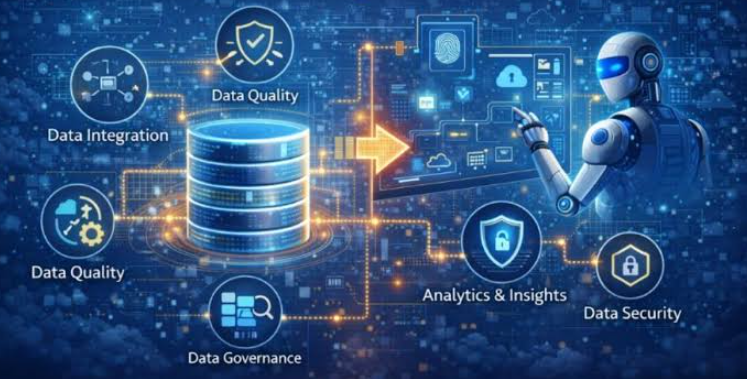
In the modern digital enterprise, data is no longer confined to centralized warehouses or monolithic storage systems. It flows across cloud environments, edge devices, SaaS applications, streaming platforms, and on-premises infrastructure. As organizations scale, they face increasing fragmentation, duplication, governance complexity, and integration challenges. The concept of a data fabric has emerged as a unifying architectural approach—an intelligent layer that connects, orchestrates, governs, and optimizes distributed data assets.
However, designing and maintaining a data fabric across hybrid and multi-cloud ecosystems is a non-trivial challenge. Static architectures and manually defined integration rules struggle to adapt to evolving schemas, dynamic workloads, regulatory changes, and new business requirements. Intelligent data fabric design using agent-based generative models represents a paradigm shift—transforming the data fabric from a passive integration layer into an adaptive, self-designing ecosystem.
Understanding the Modern Data Fabric
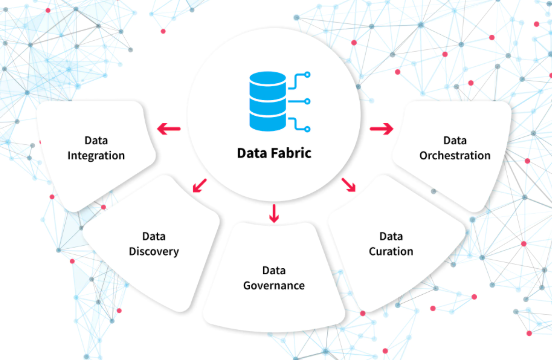
A data fabric is a metadata-driven architecture that integrates data across heterogeneous environments through unified governance, automation, and intelligent orchestration. Unlike traditional integration systems, a data fabric provides:
Real-time data discovery
Unified metadata management
Policy-driven governance
Seamless interoperability
Context-aware data delivery
Platforms often integrate distributed storage systems, streaming frameworks such as Apache Kafka, processing engines like Apache Spark, and cloud-native infrastructure across Amazon Web Services, Microsoft Azure, and Google Cloud Platform.
While these technologies provide scalability and performance, stitching them into a coherent, adaptive fabric requires intelligent coordination.
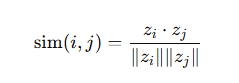
EQ1:Metadata Embedding Function
Agent-Based Generative Models: A New Design Paradigm
Agent-based generative models combine two transformative concepts:
Generative Models: AI systems capable of synthesizing configurations, schemas, transformation logic, policies, and orchestration scripts.
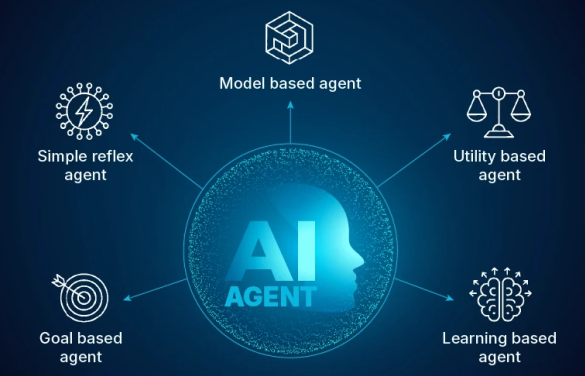
Autonomous Agents: Goal-oriented entities that perceive their environment, reason about state changes, and take actions toward defined objectives.
When embedded within a data fabric, these agents collaborate to design, evolve, and optimize the architecture itself.
Rather than engineers manually defining connectors, lineage mappings, and governance rules, agent-based generative systems analyze metadata, usage patterns, and policy constraints to produce optimized architectural blueprints.
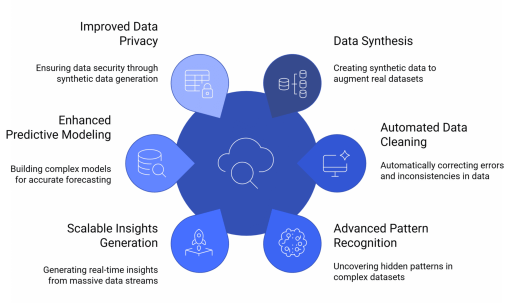
Core Components of Intelligent Data Fabric Design
1. Metadata Intelligence Layer
At the foundation of an intelligent data fabric lies rich metadata—technical metadata (schemas, formats), operational metadata (usage patterns, performance metrics), and business metadata (ownership, compliance requirements).
Agent-based generative models ingest this metadata to construct a semantic understanding of the enterprise data landscape. They detect redundancies, identify integration gaps, and recommend consolidation strategies.
For example, if multiple datasets represent similar customer attributes across regions, the system may generate a unified canonical schema and propose harmonized transformation pipelines.
2. Autonomous Topology Design
Traditional data fabric architectures are pre-defined. In contrast, agent-based generative models dynamically design topology.
Agents analyze:
Data source distribution
Access frequency
Latency requirements
Regulatory boundaries
Based on these parameters, they generate optimal connectivity graphs, decide between centralized or distributed processing, and propose caching strategies at edge locations.
If workloads shift geographically or usage patterns change, the system reconfigures routing logic automatically.
3. Intelligent Data Integration and Transformation
Integration is one of the most complex aspects of data fabric design. Heterogeneous schemas, inconsistent naming conventions, and semantic mismatches create friction.
Generative agents synthesize transformation logic by:
Mapping semantic similarities between attributes
Generating data cleansing pipelines
Inferring join relationships
Designing real-time transformation workflows
Instead of manually writing ETL code, engineers validate AI-generated transformation blueprints, significantly reducing development cycles.
4. Policy-Aware Governance Architecture
Governance in distributed ecosystems must account for privacy regulations, access control, encryption, and data residency.
Agent-based generative systems interpret regulatory requirements and organizational policies to generate enforcement rules across the fabric. For example:
Automatically configuring role-based access controls
Generating masking policies for sensitive attributes
Enforcing retention policies across storage tiers
By embedding governance logic within the generative design process, compliance becomes a native architectural property rather than an afterthought.
5. Dynamic Data Virtualization
A key promise of data fabric is seamless data access without physical movement. Intelligent agents evaluate query patterns and performance metrics to determine when virtualization is sufficient and when materialized views are necessary.
If certain analytics workloads require low-latency access, agents may generate precomputed aggregates. Conversely, rarely accessed datasets may remain virtualized to minimize storage overhead.
This continuous evaluation optimizes cost-performance trade-offs.
Multi-Agent Collaboration in Data Fabric Ecosystems
An intelligent data fabric does not rely on a single AI model. Instead, multiple specialized agents collaborate:
Discovery Agents: Identify new data sources and register metadata.
Schema Agents: Harmonize and evolve schemas.
Lineage Agents: Maintain traceability across transformations.
Governance Agents: Enforce compliance policies.
Optimization Agents: Balance cost and performance.
These agents communicate through shared knowledge graphs and event-driven coordination mechanisms. If a schema agent detects structural changes, it informs transformation and governance agents to update associated logic.
Such collaborative intelligence ensures holistic optimization rather than isolated improvements.
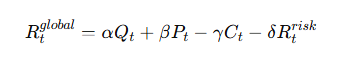
EQ2:Global Optimization Objective
Self-Evolving Architecture
One of the most powerful aspects of agent-based generative design is continuous evolution. Data ecosystems are not static; mergers, new applications, and emerging regulations constantly reshape the landscape.
Agent-based systems incorporate feedback loops:
Monitor system performance and usage metrics.
Evaluate whether architectural objectives are met.
Generate improvement strategies.
Deploy validated modifications.
Over time, the data fabric becomes self-refining—learning from operational experience and adapting proactively.
Benefits of Intelligent Agent-Driven Data Fabric
Implementing agent-based generative models in data fabric design provides several advantages:
Accelerated Deployment: Automated blueprint generation reduces architecture design time.
Reduced Human Error: Consistent AI-generated configurations minimize misconfigurations.
Improved Scalability: Dynamic topology adaptation handles growth seamlessly.
Enhanced Governance: Policies are integrated from inception.
Operational Resilience: Continuous monitoring enables self-healing adjustments.
Organizations shift from reactive integration strategies to proactive architectural intelligence.
Challenges and Design Considerations
Despite its promise, intelligent data fabric design introduces challenges:
Trust and Explainability: Generated architectural decisions must be interpretable.
Security Controls: Autonomous agents require bounded permissions.
Model Drift: Generative models must remain aligned with evolving business objectives.
Data Sensitivity: Training data for generative models must preserve privacy.
A hybrid approach—combining AI autonomy with human oversight—often provides the optimal balance.
Future Directions
As enterprises expand into edge computing and IoT ecosystems, data fabrics must extend beyond centralized cloud regions. Agent-based generative models can coordinate distributed nodes, optimize cross-region replication, and dynamically adjust for network variability.
Future advancements may include:
Federated generative agents across multi-cloud environments
Self-designing knowledge graphs
Real-time semantic reconciliation across global datasets
Integration with reinforcement learning for strategic optimization
Ultimately, intelligent data fabric design represents the convergence of metadata intelligence, generative AI, and multi-agent systems. It transforms the data fabric from a static integration architecture into a living, adaptive system capable of designing and redesigning itself in response to business, technological, and regulatory changes.
By leveraging agent-based generative models, enterprises can build data fabrics that are not only connected and governed but truly intelligent—capable of sustaining innovation in increasingly complex digital ecosystems.
Comments
Join the discussionNo comments yet. Be the first to comment.